Showing posts with label Engineering curves. Show all posts

Wednesday, September 29, 2010

Archimedes spiral

Archimedes spiral:

It is a plane curve generated by a point which moves uniformly around and towards or away from a fixed point called the “ pole “ or it is a locus of a point which moves away or towards from another fixed point at a uniform linear velocity and uniform angular velocity


When the point on the spiral moves through 360 degree, it is called on “convolution”

Practical application Scroll plate of lathe chucks, spring of clocks, watches, tooth profile of helical gears and cams etc.

Helix

Helix :


When a point moves at a constant speed along a line which revolve at a constant rate around a fixed axis. The point traces a curve similar to the coil of a spring, such a curve is called helix.
The fixed distance through which the point moves parallel to the axis for each revolution of the line is called the “pitch “of the helix. (or lead).
The helix is called as cylindrical helix when the revolving line is parallel to the axis of the revolution.

If the revolving line is inclined to the axis of revolution the resulting helix is called conical helix.

The helix may be either right handed or left handed. The right handed helix climbs from the base towards right side as it rises along the axis.


Practical application Threads on bolts, screws, nuts, springs, spiral staircase etc. have helical curves in them.


Monday, September 27, 2010

Involutes

Involutes :

It is the curve traced out by a point on a cord as it unwinds (but remains taut) around a circle or polygon


Alternatively an involute may be defined as the curve traced out by a point on a straight line which rolls around a circle or polygon without slip. Depending upon plane shape around which the line rolls, the involutes are named as involute of a triangle, involute of a square, involute of a polygon, involute of a circle etc.

The most common application of involute is seen in the manufacture of gears. The profile of a gear tooth is the shape of involute.

Hypocycloid

Hypocycloid:

When the generating circle rolls on the inside (concave side) of a larger circle, the path of the point is hypocycloid.
 
Practical application:  The cycloidal curve has its application in the design of gears and used to form gear teeth outline

Epicycloid

Epicycloid :

When the generating circle rolls on the outside (convex side) of a larger circle, the path of the point is epicycloid.

Cycloid

Cycloid:
When the generating circle rolls on a straight line, the path of the point is a Cycloid.


Saturday, September 25, 2010

Cycloidal curves

Cycloidal curves :


Cycloidal curves are generated by a point fixed on the circumference of a rolling circle when it rolls without slipping on a straight line or on  the outside / inside of another circle.
The rolling circle is called the generating circle.

The fixed straight line on which the rolling circle rolls is called the directing line or base line and is equal to the circumference of the rolling circle. (πD)

The circle on which (either outside or inside) the rolling circle rolls is called directing circle or base circle.

Cycloidal curves are three type:
1.Cycloid   
2.Epicycloid 
3.Hypocycloid

Hyperbola

Hyperbola
It is a curve generated by a point ‘p’ moving in such a way that the distance from focus to the fixed straight line (directrix) is constant and is always greater than 1.


Practical application:  In design of water channels. Further it also represents Boyle’s law graphically and in design of electronics’ transmitter receiver and radar antenna

Parabola

Parabola
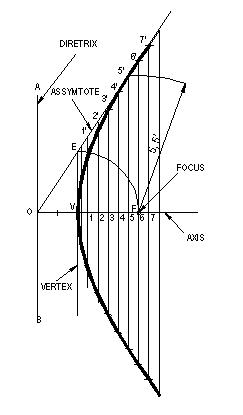
It is curve generated by a point ‘p’ moving in such a way that its distance from fixed point          (focus) and directrix remains constant and is always equal to 1

 Practical application:  Search lights, reflecting surfaces for light and sound, bridge arches, wall brackets and largely used in graphic methods for determining the stress upon the beams and girders etc.

Ellipse

Ellipse
It is a curve generated by a point moving in such a way that it distance from two fixed points (foci) is always constant and is always less than 1.


Practical application: In general, a circle in pictorial drawing is represented by an ellipse. The use of elliptical shape is rarely used for engineering applications. Ellipse is dealt extensively in mathematical books. Elliptical shape is adopted for better aesthetics.